Insights from the Fifth Global Digital Trade Expo and the Road from AI Technology to Practical Applications
AI application deployment remains the biggest barrier for global AI teams turning concepts into working physical systems.
Turning AI concepts into real‑world applications requires more than advanced AI models. It requires practical solution design, system integration, engineering validation, and reliable deployment capabilities. This is where Qualenex helps organizations bridge the gap between AI innovation and real‑world implementation.
Artificial intelligence is moving beyond the digital world.
For years, much of the AI industry has focused on models, software, data, cloud computing, and digital platforms. Today, another transition is becoming increasingly visible: AI is entering the physical world.
Robots, intelligent devices, autonomous systems, industrial equipment, and other AI-enabled products are bringing intelligence into real environments.
As this transition accelerates, a new challenge is becoming increasingly important:
How do we turn AI capabilities into reliable, deployable real-world applications?
Our visit to the Fifth Global Digital Trade Expo in Hangzhou offered a valuable window into this transition — and into the evolving AI ecosystem in Zhejiang.
From Digital Intelligence to Physical Intelligence
One of the most noticeable trends at the expo was the growing connection between AI and physical systems.
AI is no longer limited to software interfaces or cloud-based applications. It is increasingly being combined with sensors, computing platforms, control systems, mechanical components, robotics, and industrial equipment.
This shift is particularly visible in embodied intelligence.
Humanoid robots and other intelligent machines require much more than an AI model. They require perception, computing, motion control, mechanical systems, electronics, software integration, testing, and real-world validation.
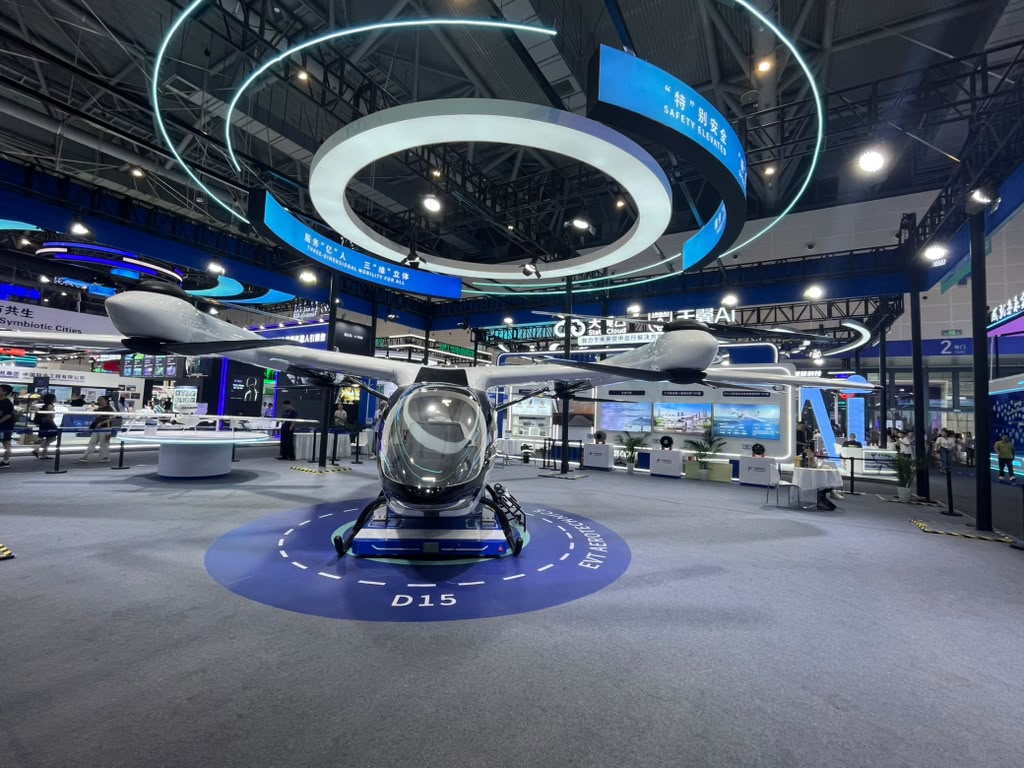
The same direction can be seen beyond robotics. Intelligent terminals, autonomous systems, and emerging forms of intelligent mobility all reflect a broader transformation:
AI is becoming part of the physical systems that operate in the real world.
And once AI enters the physical world, implementation becomes just as important as innovation.
Why Zhejiang Is Worth Watching
Zhejiang provides an interesting example of how different parts of the AI and industrial ecosystem can connect.
Hangzhou has built a strong foundation around AI, digital technology, software, data, cloud services, and the broader digital economy. It provides an environment where AI technologies and digital applications can be developed and commercialized.
Beyond Hangzhou, other parts of Zhejiang contribute different capabilities.
Ningbo represents an important manufacturing and industrial base, with strengths across manufacturing, electromechanical products, industrial supply chains, and related infrastructure.
Shaoxing and Shangyu are also becoming increasingly relevant to embodied intelligence and intelligent manufacturing, particularly where robotics, testing, industrial applications, and manufacturing capabilities begin to intersect.
These regions do not need to have identical strengths to form a meaningful ecosystem.
Their value lies partly in how different capabilities can complement one another.
Digital intelligence, industrial manufacturing, engineering capabilities, testing infrastructure, and application scenarios can become connected across the region.
Hardware and manufacturing capabilities are important enablers of AI deployment, but successful implementation requires the organic integration of technology, engineering, and actual application scenarios.
From an AI deployment perspective, this distributed structure is one of the characteristics that makes Zhejiang particularly interesting.
Shangyu: Where Embodied AI Meets Industrial Infrastructure
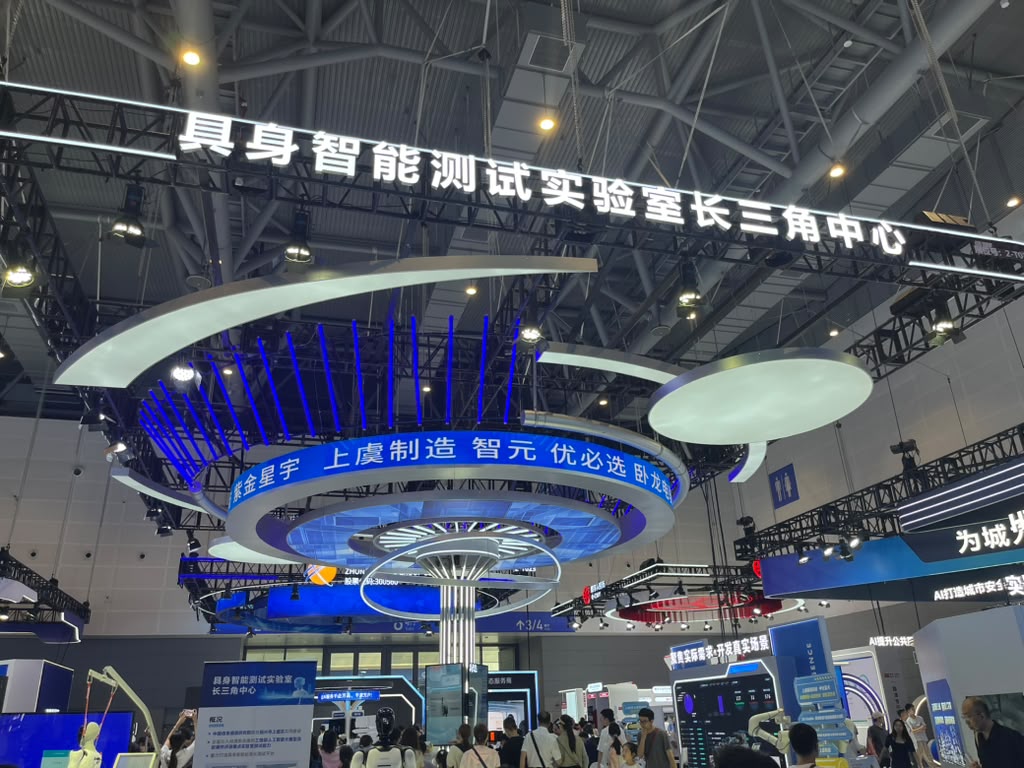
During our visit to the expo, one of the displays that stood out was the embodied-intelligence testing and industry ecosystem connected with Shangyu.
The exhibition brought together a public testing platform and multiple companies working across robotics and related technologies, including Zhiyuan Robot, UBTECH, Wolong, Yifei, and others.
What stood out was not simply the presence of robots.
More importantly, the display reflected a broader development pattern:
technology + testing + industrial partners + application scenarios.
This matters because embodied AI cannot move directly from a laboratory to commercial deployment.
Between the two, there are many practical steps:
Prototype → Testing → Validation → Scenario Adaptation → Deployment
Testing platforms, engineering capabilities, component suppliers, manufacturers, and industrial application environments all play a role in this process.
For AI companies developing physical products, this type of infrastructure can provide an important environment for prototype testing, technical validation, and scenario adaptation before deployment.
The real value of an AI ecosystem is therefore not simply how many companies it contains.
It is also about how effectively technology can move from development to validation and eventually into real-world applications.
The Real Challenge for Global AI Companies
For an AI company, developing a capable model or software platform is only one part of the journey.
Imagine an overseas AI team that has developed an AI model, software platform, or promising application concept.
The next questions may be very different:
What hardware should be used?
How should the system be integrated?
Which sensors, computing platforms, controllers, or mechanical components are appropriate?
How should the prototype be built?
How can the system be tested in a real environment?
How can the final solution be manufactured, deployed, and maintained?
These are not purely AI questions.
They are implementation questions.
And this is where the gap between an AI concept and a commercial application can become significant.
Having AI technology is one thing. Turning it into a reliable, deployable product is another.
Where Qualenex Fits
This is where we see the role of Qualenex.
Qualenex is not a foundational AI model developer, nor are we a traditional contract manufacturer.
Our focus is on the AI application implementation layer — connecting the right technologies, engineering capabilities, hardware, manufacturing resources, and implementation capabilities to turn AI concepts into deployable applications.
We work with AI teams and technology partners to understand the application requirements first, and then coordinate the resources needed to move the project forward.
Depending on the project, this can include:
- Requirement assessment and application planning
- Solution architecture and implementation design
- Hardware and software selection
- System integration
- Prototype development
- Testing and validation
- Supply-chain coordination
- Deployment and commissioning
- Project delivery
The objective is not simply to assemble hardware or connect software.
The objective is to create a solution that can actually work in the intended environment.
That means connecting the right technologies, coordinating the right partners, and helping the system move from concept to prototype, from prototype to validation, and from validation to deployment.
Connecting Global AI Innovation with Real-World Capabilities
We believe the next stage of AI development will require stronger connections between AI innovation and the physical world.
For global AI companies, access to the right engineering, hardware, manufacturing, testing, and supply-chain capabilities can be an important part of that journey.
For technology ecosystems such as Zhejiang, the opportunity is not simply to develop AI technologies, but to help those technologies become products, systems, and applications that operate in real environments.
This is where we see an important role for Qualenex.
By connecting global AI innovation with appropriate technology and industrial capabilities in China, we aim to help our partners move beyond the model or software layer and toward practical deployment.
We do not replace our partners’ core AI expertise.
Instead, we help connect the different pieces around their technology so that promising ideas have a clearer path toward becoming real applications.
From AI Concepts to Real-World Applications
The Fifth Global Digital Trade Expo gave us another perspective on how quickly AI is expanding from digital technology into physical systems and industrial applications.
From Hangzhou’s digital and AI capabilities, to the broader manufacturing network across Zhejiang, to emerging embodied-intelligence and testing capabilities in places such as Shangyu, different parts of the ecosystem are beginning to connect around a common challenge:
How do we make AI work in the real world?
For Qualenex, this is more than an industry trend.
It is the direction we are building toward.
We believe the value of AI is ultimately measured not only by what a model can do, but by what that intelligence can become in the real world.
By working with the right technology and industry partners, we aim to help bridge the gap between innovation and implementation.
Have an AI concept or product idea?
Qualenex helps transform AI concepts into practical solutions through full‑stack design, system integration, engineering validation, and deployment.
Accelerate AI from Concept to Real‑World Application, Together.
Leave a Reply