Understanding Real Factory Needs Beyond the Hardware
Intelligent industrial inspection is critical for modern manufacturing. For plant managers, maintenance teams and quality professionals, effective inspection identifies potential equipment faults, stabilizes production and maintains consistent operational standards.
Even factories with mature inspection workflows and dedicated staff still face common pain points: undetected anomalies, inconsistent inspection logs, and poor visibility of equipment conditions across work shifts.
These challenges raise an important question: If factories already have inspection processes in place, what additional value can intelligent inspection actually deliver?
The answer is not simply about replacing manual labor with robots. It requires a deeper understanding of factory operations, existing inspection methods, technology limitations, and the practical conditions under which intelligent systems can deliver measurable value.
At Qualenex, we believe successful AI deployment begins with understanding real application needs. Rather than assuming that one technology or hardware configuration fits every factory, we focus on the relationship between operational challenges, technical capabilities, and practical implementation.
1. The Real Challenges of Traditional Equipment Inspection
Manual inspection remains essential in many manufacturing environments. Experienced workers can recognize unusual sounds, smells, vibrations, and other contextual signals that automated systems may not easily interpret.
However, traditional inspection methods also have limitations that deserve attention.
1.1 Human Error and Missed Abnormalities
Production schedules, frequent equipment changes, repetitive tasks, and time pressure can affect inspection consistency.
Potential problems include:
- Inspection points being overlooked during busy production periods
- Abnormal readings not receiving sufficient attention
- Small oil leaks, gradual pressure changes, or unusual temperature readings going unnoticed
- Reduced inspection coverage during night shifts or periods with limited staffing
Not every missed inspection leads to equipment failure. However, when early warning signs go undetected, some problems can develop into unexpected downtime, product quality issues, or costly maintenance events.
Intelligent inspection may help reduce these gaps by automating repetitive checks and applying consistent inspection procedures. Its effectiveness, however, depends on whether the system can reliably recognize the relevant abnormalities in the actual operating environment.
1.2 Incomplete Records and Limited Traceability
Inspection is not only about identifying problems. It is also about documenting what was checked, when it was checked, what was observed, and how abnormalities were handled.
Traditional paper-based or manually maintained records may contain incomplete information, delayed entries, inconsistent descriptions, or insufficient supporting evidence.
For factories operating under ISO-based quality management systems, automotive industry requirements, or international customer audits, these limitations can make inspection activities more difficult to verify.
A well-designed digital inspection system can help standardize recordkeeping through:
- Timestamped inspection records
- Identification of inspection locations and equipment
- Original images or other supporting evidence
- Consistent abnormality classification
- Follow-up records documenting corrective actions and resolution
Digital records can improve traceability and support internal reviews and applicable audit processes. However, whether they satisfy a particular audit or regulatory requirement depends on the relevant standard, customer requirements, and implementation details.
The objective is not simply to generate more data. It is to produce reliable, usable evidence that supports better equipment management.
1.3 Inspection Knowledge Is Difficult to Preserve
Experienced maintenance personnel often develop valuable knowledge through years of working with specific machines and production environments.
When employees change positions or leave, some of that knowledge may be lost if it has not been documented systematically.
Over time, this can make it difficult to compare equipment conditions, identify recurring abnormalities, or recognize gradual changes that may indicate a developing problem.
Intelligent inspection systems can help preserve part of this knowledge by consistently collecting equipment readings, images, inspection results, and historical records.
When combined with appropriate analysis, these records may support trend monitoring and maintenance planning. More advanced predictive capabilities, however, require suitable data, validated analytical methods, and sufficient operating history.
The practical question is how to turn inspection data into information that maintenance teams can actually use.
2. Why One Inspection Technology Cannot Fit Every Factory
The intelligent inspection market includes a growing range of technologies, including fixed cameras, mobile inspection robots, quadruped robots, humanoid robots, wearable devices, and sensor-based monitoring systems.
Each has its own advantages and limitations.
For factories considering intelligent inspection, the key decision is not which technology appears most advanced. It is which approach best matches the operating environment, inspection requirements, and available budget.
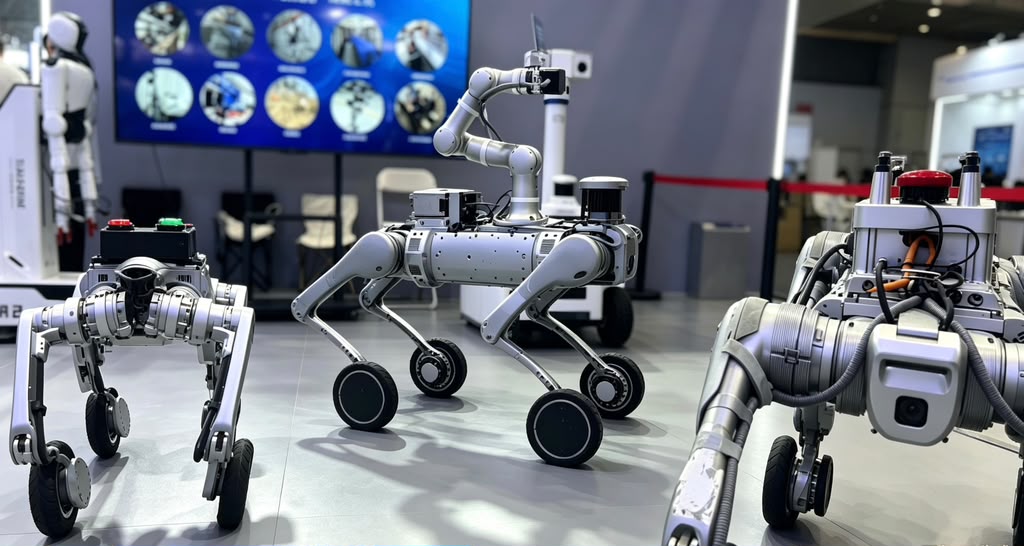
2.1 Humanoid and Quadruped Robots
Humanoid and quadruped robots attract attention because of their mobility and potential ability to operate in environments with obstacles, stairs, or changing terrain.
In certain industrial settings, these capabilities may provide meaningful advantages.
However, their suitability for routine inspection in ordinary manufacturing workshops depends on several factors:
- Whether complex mobility is actually required
- Whether the inspection tasks justify the hardware cost
- Whether the robot can operate reliably around workers, machines, and production materials
- Whether battery life, maintenance, and recovery procedures meet operational requirements
For a workshop with relatively flat floors and clearly defined inspection points, a simpler mobile platform or fixed monitoring system may be more economical.
Conversely, a more capable robot may be justified when the environment or inspection tasks demand greater mobility.
The objective should be to avoid both unnecessary complexity and insufficient capability.
2.2 Tracked and Specialized Mobile Platforms
Tracked inspection platforms may be suitable for rough terrain, uneven surfaces, or environments where conventional wheeled systems have difficulty operating.
In indoor manufacturing workshops, however, their size, maneuverability, maintenance requirements, and compatibility with existing pathways must be evaluated carefully.
Their suitability depends on the specific environment rather than the mobility mechanism alone.
2.3 AR Wearables and Human-Assisted Inspection
Augmented reality devices and wearable inspection tools can guide workers through standardized procedures, provide access to technical information, and improve the consistency of manual checks.
They may be particularly useful when inspections require human judgment, specialized knowledge, or direct interaction with equipment.
However, wearable devices do not independently eliminate the need for personnel to perform inspections. They also may not address unattended periods unless combined with other monitoring technologies.
In many situations, human-assisted inspection and automated monitoring are complementary rather than competing approaches.
2.4 Fixed Cameras and Sensor-Based Monitoring
Fixed cameras and sensors can provide continuous monitoring of specific equipment or locations without requiring a mobile robot to travel between inspection points.
Depending on the application, computer vision can help read instrument displays, detect visible leaks, identify indicator-light changes, or recognize other observable conditions.
Sensors may also monitor parameters such as temperature, vibration, or pressure when appropriate measurement hardware is available.
These approaches can be relatively straightforward when inspection points are stable and well defined.
Their limitations include restricted coverage, installation constraints, changing lighting conditions, occlusion, sensor suitability, and the difficulty of monitoring locations outside their configured range.
For larger or changing workshops, multiple fixed systems or a combination of fixed and mobile inspection may be more appropriate.
The key principle is that inspection hardware should be selected according to the task, not the popularity of the technology.
3. What Should Factories Actually Expect from Intelligent Inspection?
Once the operational requirements are understood, the next step is to define what a practical solution must achieve.
Rather than starting with a particular robot or software platform, factories should evaluate intelligent inspection against several fundamental requirements.
3.1 Reliable Performance Under Real Operating Conditions
Industrial environments differ significantly from controlled demonstrations.
Dust, oil contamination, reflections, changing illumination, vibration, worn instrument displays, and variations in equipment positioning can all affect system performance.
A solution that works well in a laboratory may not achieve the same results on an active production floor.
Testing should therefore focus on the actual inspection task and environment.
Important evaluation criteria may include:
- Recognition accuracy under representative operating conditions
- False alarm and missed detection rates
- Repeatability across different shifts and operating states
- Performance when displays, equipment, or environmental conditions change
- System availability and recovery from common failures
No system can guarantee zero false alarms or missed detections in every environment. The goal is to establish acceptable performance thresholds, validate them through testing, and monitor performance after deployment.
3.2 Meaningful Coverage During Unattended Periods
Night shifts and other periods with limited staffing may create inspection gaps, depending on how a factory organizes its operations.
Automated inspection can help extend monitoring coverage by performing scheduled checks or continuously observing selected equipment.
However, unattended operation involves more than moving a robot along a route.
The solution must also account for charging, connectivity, blocked pathways, equipment access, unexpected obstacles, system faults, and procedures for responding when an abnormality is detected.
A useful system should not merely complete a patrol. It should reliably identify what requires attention and communicate the result to the appropriate personnel.
3.3 Traceable Records and Actionable Reports
An intelligent inspection solution should produce records that are useful to maintenance teams and management, not just data that accumulates in a dashboard.
Depending on the application, useful outputs may include:
- Inspection timestamps and equipment identifiers
- Images, readings, and inspection results
- Abnormality categories and severity levels
- Notifications and escalation records
- Follow-up actions and resolution status
- Historical records for trend analysis
For factories serving international customers, multilingual reporting may also be useful.
The reporting format should be designed around the factory’s existing workflows and applicable documentation requirements. Simply digitizing a paper checklist does not automatically establish compliance or improve decision-making.
The real value comes from connecting inspection, evidence, and follow-up into a consistent process.
3.4 Practical Deployment With Minimal Production Disruption
Factories must consider not only whether a technology works, but also how it can be introduced into existing operations.
Extensive equipment modifications, complex commissioning, prolonged production interruptions, and difficult maintenance procedures can undermine an otherwise promising solution.
Where feasible, a practical deployment approach should prioritize:
- Compatibility with existing equipment and workflows
- Minimal changes to production infrastructure
- Clear installation and commissioning procedures
- Appropriate integration with existing systems
- Manageable maintenance and support requirements
- A staged pilot before wider implementation
Some applications may operate independently using cameras, sensors, or mobile devices. Others may require PLC connectivity, industrial network integration, or modifications to existing equipment.
A no-modification approach should therefore be treated as a design objective where practical, rather than a universal technical guarantee.
The right level of integration depends on what the application must accomplish.
4. From Technical Possibility to Practical Industrial AI Deployment
Many intelligent inspection capabilities already exist. The challenge is determining how to combine them into a solution that works reliably within a particular factory.
This requires more than choosing a robot, installing a camera, or connecting an AI model.
It involves understanding the operational problem, defining measurable requirements, selecting suitable technologies, coordinating hardware and software, validating performance, and planning for long-term operation.
For example, a factory that needs to read pressure gauges at several fixed locations may not need a mobile robot at all. A camera-based vision system could be sufficient if the viewing conditions and required accuracy are manageable.
A different factory may need a mobile platform because inspection points are distributed across a large workshop. Another application may require both visual recognition and additional sensors because the relevant equipment condition cannot be reliably determined from images alone.
These scenarios illustrate why the same hardware configuration cannot be assumed to work equally well everywhere.
A Practical Approach to Solution Development
A structured deployment process can reduce uncertainty and help prevent unnecessary investment.
Step 1: Understand the application.
Identify the equipment, inspection points, existing procedures, operating conditions, and specific problems the factory wants to address.
Step 2: Define success criteria.
Establish measurable requirements for recognition accuracy, inspection coverage, response time, recordkeeping, reliability, and acceptable cost.
Step 3: Evaluate suitable technologies.
Compare fixed vision systems, sensors, mobile platforms, existing robots, and relevant software according to the actual requirements.
Step 4: Validate through a limited pilot.
Test the proposed configuration under representative operating conditions. Record performance, limitations, maintenance needs, and any necessary adjustments.
Step 5: Assess operational and commercial viability.
Consider the total cost of deployment and ownership, including integration, maintenance, downtime risks, software support, and the value of the problems being addressed.
Step 6: Scale only when the evidence supports it.
Expand the solution when the pilot demonstrates that the required performance, operational benefits, and economic assumptions are sufficiently supported.
This process is not unique to intelligent inspection. It reflects a broader principle for industrial AI deployment: a technology should be evaluated against the real problem it is expected to solve.
5. The Qualenex Perspective: Application Requirements Come Before Technology Choices
At Qualenex, we view AI application deployment as the process of connecting technological capabilities with practical operational needs.
Our focus is not limited to a particular robot category, hardware product, or industrial application. We are interested in understanding where AI can create meaningful value, what capabilities are required, and how suitable technologies can be coordinated and implemented in real-world environments.
For industrial intelligent inspection, this means looking beyond the hardware itself.
The relevant questions include:
- What problem is the factory actually trying to solve?
- Which parts of the inspection process can be automated reliably?
- What combination of AI, vision, sensors, hardware, and software is appropriate?
- How will the solution work within existing production conditions?
- What evidence will demonstrate that it delivers practical value?
- Can the solution be maintained, replicated, and scaled economically?
The answers will differ from one factory to another.
In some cases, the best solution may involve an existing robot integrated with suitable vision software. In others, a simpler camera-based system or a combination of sensors and software may be more appropriate. Some applications may not yet justify automation at all.
A professional implementation process must be willing to evaluate these possibilities objectively.
Our approach is to help bridge the gap between AI capabilities and real-world applications through solution planning, hardware-software coordination, technology and supply-chain matching, integration support, and deployment-oriented problem solving.
The objective is not to introduce technology for its own sake. It is to identify an appropriate solution for a clearly defined need and establish a practical path toward implementation.
Conclusion: The Best Inspection Solution Is the One That Works in the Real World
Intelligent industrial inspection offers opportunities to improve inspection consistency, extend monitoring coverage, strengthen traceability, and support equipment management.
However, these benefits are not automatic. They depend on the application, the operating environment, the selected technologies, and the quality of implementation.
Humanoid robots, quadruped robots, mobile platforms, fixed cameras, sensors, and human-assisted systems each have potential roles. None should be considered the universal answer to every factory’s inspection challenges.
For manufacturers, the starting point should be a clear understanding of operational needs, measurable performance requirements, and the practical value expected from deployment.
For technology providers and integration partners, the responsibility is to connect suitable capabilities with those needs, validate assumptions in real operating conditions, and address the engineering and operational challenges that emerge along the way.
At Qualenex, we believe successful AI deployment begins with the right problem, the right technology combination, and a practical path to real-world implementation.
We work to help turn AI concepts into real-world applications through solution coordination, hardware-software integration, and deployment-focused execution.
Accelerate AI from Concept to Real-World Application.
Have an AI application or industrial integration project in mind?